
Talk to ForestsUnderstandthe Trees
 Meet gAIa
“gAIa voices our collective intelligence on trees
Our knowledge of trees is vast—but scattered. Some data sits behind expensive licences. Some is outdated. And for many trees, it simply doesn't exist. This is especially true on private land, which can make up a large share of a city's canopy. For urban greening teams, that creates a blind spot. And when local experts move on, much of their practical knowledge goes with them.
Trees are as essential as roads or bridges. They clean the air, cool our streets, reduce flood risk, and make neighbourhoods healthier and more liveable. They are also living landmarks—hosts to biodiversity and holders of collective memory. Yet because these benefits are hard to see and measure, trees too often appear only as costs.
gAIa is an AI companion for trees, built for everyone—from school children to senior arborists. It helps people learn, contribute observations, and take care actions in both public and private spaces. It also brings together data, local knowledge, and simulations, so users can explore how trees might grow and what benefits they may provide over time.


Learn care. Feel connection. See impact.
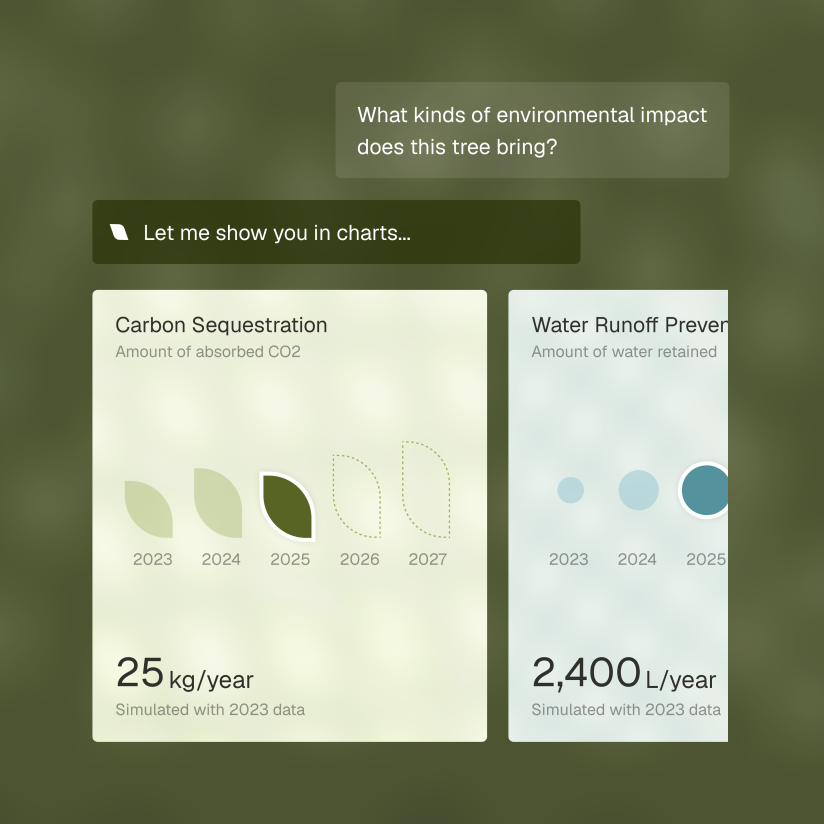
Impact you can see
Good for urban planners, greening initiatives, and municipal officers.
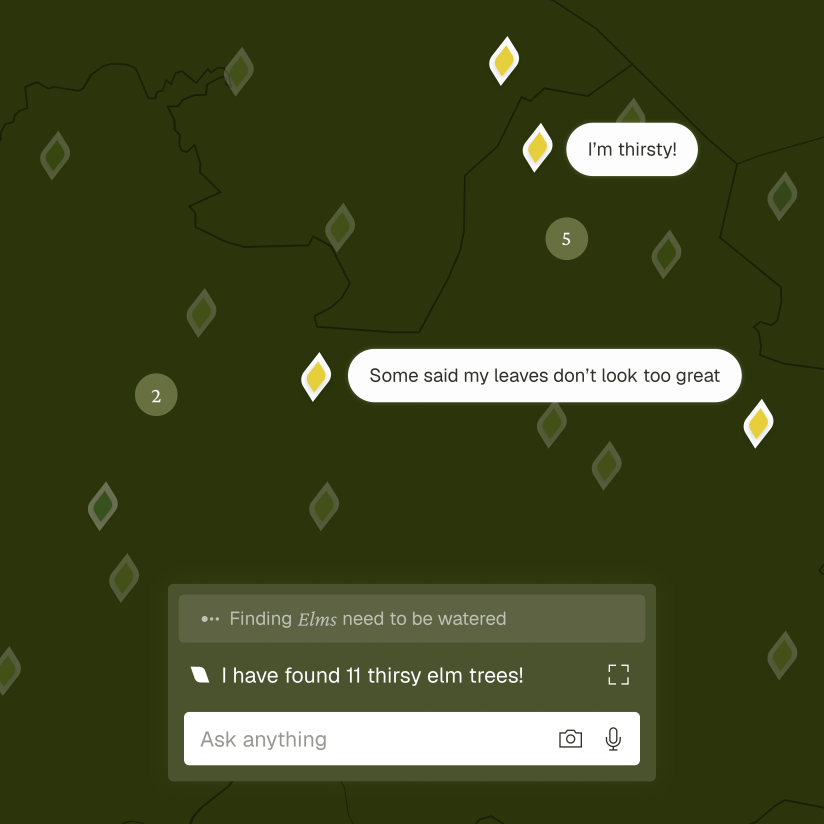
Care with guidance
Good for arborists, municipal teams, and citizens who want practical, timely tree-care guidance.
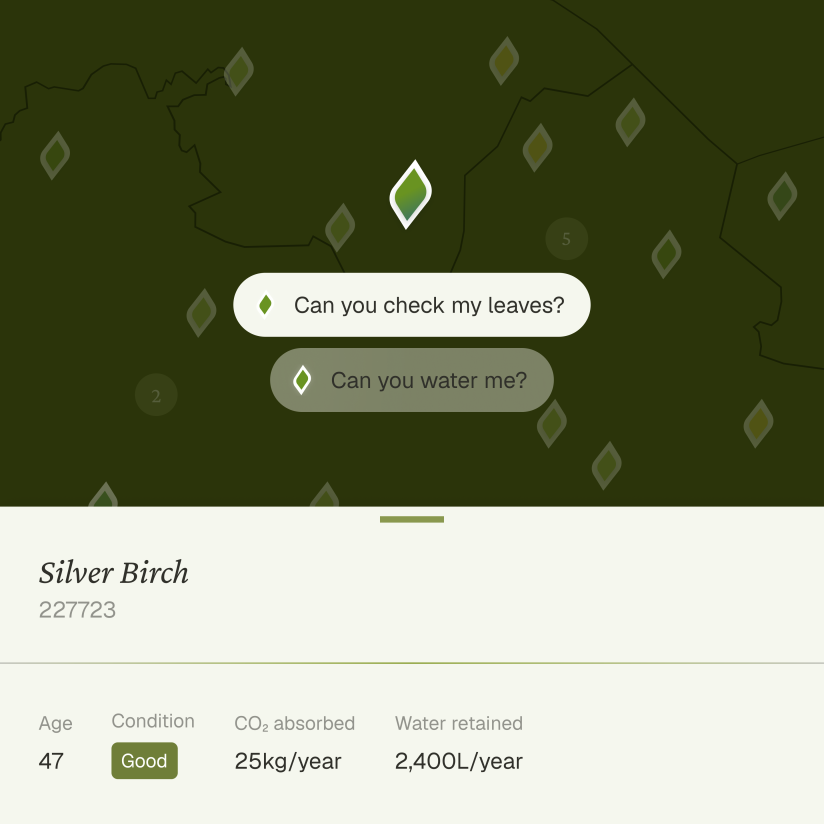
Nature with context
Good for citizen science campaigns, participatory education in schools, and preserving the natural heritage of monumental trees and parks.
How It Works
Ask a Question
Start a conversation with gAIa about any tree or forest in your area.
Get Real Insights
Receive data-driven answers powered by scientific models and real measurements.
Take Action
Use insights to make informed decisions about tree care and urban planning.
Behind the Scenes
Discover the technology and principles that power gAIa's insights

Transparent by Design
Every answer is powered by real tree data, scientific models, and open city databases.
Backed by Advanced Simulations
Forecasts of carbon, biodiversity, cooling, and water are generated through a validated agent-based simulation engine called GUS.
Learn about GUSDriven by Knowledge Graphs
Context comes from linked ecological data and scientific research, making each conversation accurate and grounded.

gAIa grows stronger with every contribution
Citizens, researchers, and cities all play a role in shaping a living map that makes nature's value visible and actionable.
Join us in giving voice to the trees.
Supported By


Book a live gAIa demo
Choose an available slot directly from our live calendar and we'll walk you through gAIa, the product experience, and how it can support your urban forest work.
Frequently asked questions
Everything you need to know about gAIa and the urban forest intelligence platform.
gAIa is an AI-powered urban forest intelligence platform — a living map of trees where every tree has a voice. You can ask plain-language questions about trees and forests in your city and get real, data-driven answers: which trees need attention, how much carbon your neighbourhood's canopy captures, which species are struggling this season, and more. It's built on top of GUS (Green Unified Scenarios), an agent-based simulation engine, and uses knowledge graphs, RAG (retrieval-augmented generation), and large language models to make complex ecological data accessible to everyone — from arborists and city planners to curious citizens.
gAIa is currently in early access. You can book a free 30-minute demo to see the platform in action and discuss how it fits your organisation or city. Reach out via gaia.gus.earth to get started.
gAIa is powered by GUS (Green Unified Scenarios), an agent-based simulation engine built specifically for urban tree and ecosystem modelling. Simulations can model the future impacts of individual trees or entire clusters — including:
- Carbon capture — how much CO₂ a tree or mini forest is sequestering over time
- Urban cooling — shade and evapotranspiration effects that reduce heat island intensity
- Air quality improvement — particulate matter and pollutant absorption by species
- Biodiversity support — habitat and connectivity contributions
- Water runoff reduction — interception and infiltration effects
Simulations run against real tree data and configurable scenarios, so city planners and green space managers can compare outcomes before making decisions. The GUS simulation API is also available directly at backend.gus.earth/docs.
A mini forest — or cluster — is a named group of trees managed together in gAIa. Clusters can represent anything from a small community planting to a formal urban woodland. You can start conversations with a cluster as a whole ("How is this mini forest doing?"), run simulations across the group, and track collective ecosystem services over time. Clusters are a core unit in the GUS framework and have their own health indicators, maintenance histories, and simulation profiles.
gAIa combines multiple data sources:
- Open city databases — municipal tree inventories from participating cities
- Scientific species models — growth rates, drought tolerance, seasonal behaviour, and ecosystem service estimates per species
- Community observations — measurements, photos, and condition reports contributed by users
- Weather data — real-time and seasonal weather integrated to flag risks like drought stress or storm damage
- Soil data — soil condition context where available
All answers are grounded in this real data. gAIa is designed to be transparent: it tells you where its information comes from and flags data gaps rather than guessing.
Yes. You can add trees to gAIa individually through conversation (gAIa will walk you through the details it needs) or in bulk via the API at api.gus.earth. Once a tree is in the system it becomes part of the living map — it gets a memory, it receives alerts, and it can be included in simulations. Trees can be assigned to clusters (mini forests), linked to species profiles, and enriched over time with photos and observations.
Yes. Tree profiles in gAIa support images, and you're encouraged to photograph your trees to build a richer record. Photos help document condition changes over time and make tree profiles more useful for community members and professionals alike. You can attach images to a tree through the app or via the API.
gAIa uses multimodal AI and can work with tree photos to support condition assessment and observation recording. When you submit a photo as part of a conversation or data-collection flow, gAIa can help interpret what it sees — identifying visible signs of stress, disease, or damage — and link that observation to the tree's memory and alert system. Photo analysis capabilities continue to improve as the platform evolves.
gAIa generates smart, tree-level alerts based on a rules engine that evaluates each tree's data. Alert types include:
- Maintenance due — trees overdue for inspection or care based on condition and history
- Weather warnings — species-specific vulnerability flags during heat waves, storms, or drought
- Health concerns — trees in poor or critical condition that need attention
- Seasonal information — timely actions for pruning, planting, or disease prevention by species
- Data quality — trees with outdated or missing records that reduce accuracy
- Unknown species — unidentified trees that would benefit from community input
Alerts are prioritised by severity (critical → high → medium → low), shown on the map, and available in five languages. Clicking an alert opens a conversation with gAIa for context and next steps.
gAIa currently supports English, Dutch (Nederlands), German (Deutsch), French (Français), and Spanish (Español). Chat responses, alerts, and data-collection flows are all localised. More languages can be added — contact us if your city needs a specific language.
Yes. gAIa at ai.gus.earth is a responsive web application designed to work on smartphones and tablets. You don't need to install an app — open it in your mobile browser and you can chat with trees, browse the map, and submit observations in the field.
Yes. The gAIa platform exposes a full REST API at api.gus.earth. The API supports:
- Querying trees by location (bounding box), species, condition, and other filters
- Fetching alerts for individual trees or geographic areas
- Running GUS ecosystem simulations for clusters
- Managing tree data, clusters, and populations
- Accessing episodic tree memory and conversation history
- Multi-language support across all endpoints
The underlying GUS simulation engine also has its own API at backend.gus.earth/docs, which can be used independently for scenario modelling.
GUS (Green Unified Scenarios) is the agent-based simulation and tree management framework that powers gAIa's backend. GUS manages the canonical tree and cluster data, runs ecosystem simulations, and handles species modelling. gAIa is the conversational AI layer on top of GUS — it translates questions and insights between users and the GUS data model. You can interact with GUS directly via its API, or use gAIa as a natural-language interface to the same underlying data.
gAIa grounds its answers in real data from city inventories, scientific species models, and community observations. It uses knowledge graphs and RAG (retrieval-augmented generation) to cite actual tree records rather than hallucinating. When data is incomplete, stale, or missing, gAIa says so — and may generate a data-quality alert to flag the gap for the community to fill. Simulation outputs are estimates based on established ecological models; they improve as tree records are enriched with observations and photos.
Each tree in gAIa has its own episodic memory — a persistent record of conversations, observations, measurements, and condition reports over time. When you talk to a tree today, gAIa can draw on everything that's been recorded about it previously. Memory is stored semantically, so it can surface relevant past observations even when they weren't tagged the same way. This makes long-term tree care more effective: arborists can see a tree's history at a glance, and community members build a collective picture over time.
gAIa is designed for anyone who cares about trees:
- Arborists and tree managers — prioritise maintenance, track health, and run simulations for planning
- City planners and green space teams — understand ecosystem services and make data-informed decisions
- Researchers and ecologists — access structured tree data and scenario modelling via the API
- Community groups and citizens — contribute observations, explore local trees, and participate in urban forest stewardship
- Developers and data teams — integrate gAIa and GUS via the REST API into dashboards, reporting tools, and smart-city platforms