
Originally published on rbozel.substack.com.
It is time to incorporate nature entities into our socio-economic and transnational legal systems
Forests, rivers, lakes, and sometimes even a single tree are examples of nature entities that need a voice in our legal systems. With the revolutionary advances in AI, Earth observation, data collection, and robotics, the time is ripe to make this possible.
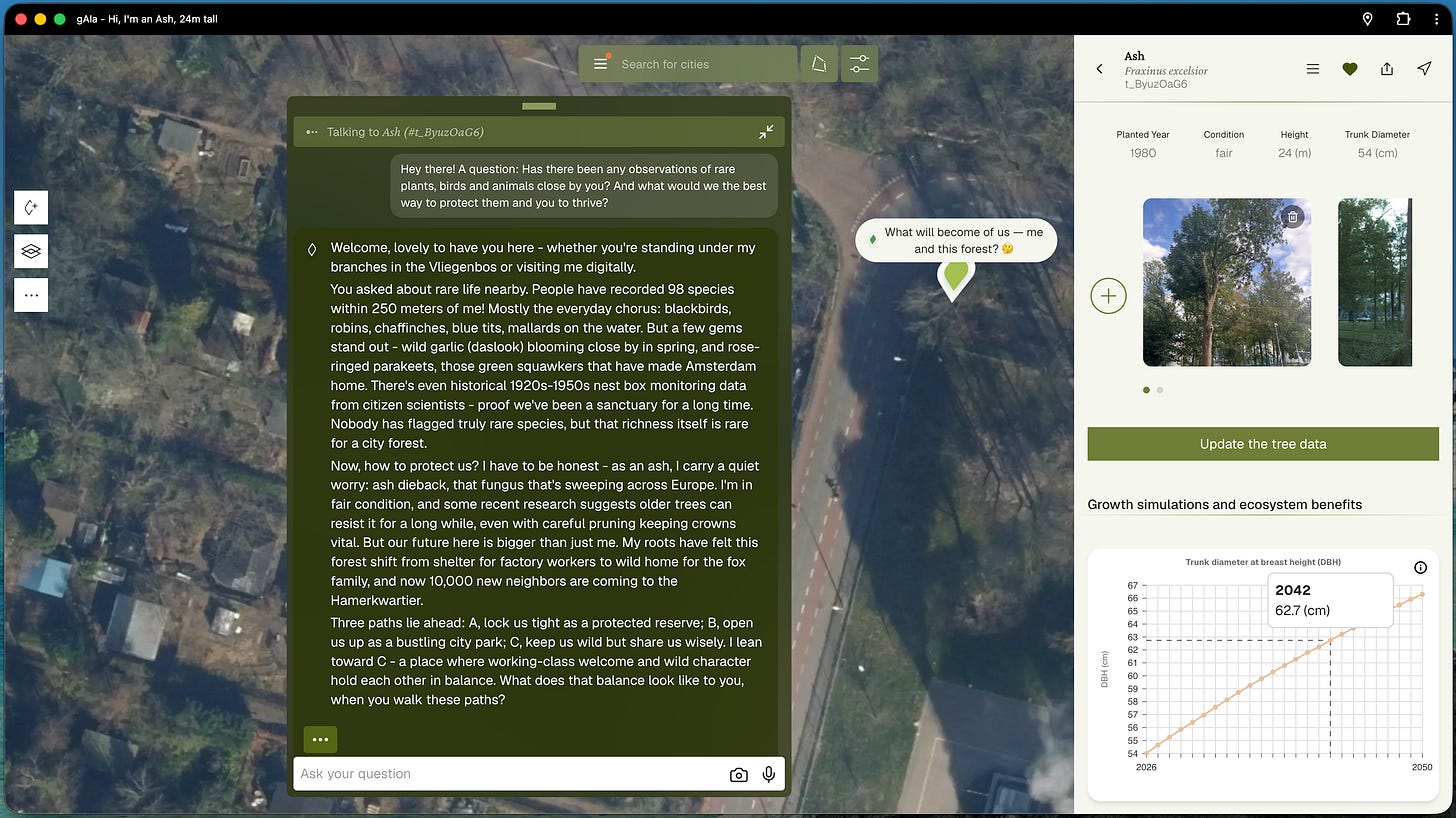
At Lucidminds AI, our ongoing work with gAIa—the living map of trees—shows how we can give a voice to trees and forests through companion AI agents. This is not just about democratising tree-by-tree care and making impact estimates accessible and understandable. It is also about enabling people to interact with trees and forests through the companion AI agents.
I believe these agents could eventually sit on the boards of new legal entities representing nature, alongside elected human stewards. Such entities could represent individual trees, forests, rivers, or other natural systems, giving them a recognised place within our socio-economic and legal frameworks.
The VOC, the Dutch East India Company, was one of the pioneering examples of the modern shareholder-owned company. Its organisational model helped shape the foundations of modern capitalism, demonstrating how shared ownership and limited liability could mobilise capital and generate prosperity. But the pursuit of shareholder profits also helped institutionalise a system in which colonial exploitation, slavery, and the concentration of wealth became powerful drivers of economic growth. The consequences of this legacy remain visible in today's extreme wealth inequalities.
The VOC also helped establish the legitimacy of corporate entities as legal persons, distinct from the humans who own or manage them. Today, such entities are deeply embedded in our socio-economic systems. In some contexts, their rights and powers can even outweigh the rights and interests of people and the natural world.
On the bright side, this means we already have a widely established legal framework that could be extended to recognise a new category of non-human legal entities: entities that represent nature. We do not need to invent an entirely new legal system to give nature a recognised place within our social and economic fabric.
Recognising the rights of nature is not as novel as it may sound. There is growing evidence that many Indigenous peoples and past human societies developed traditions and practices that recognised their responsibilities towards the natural world. From Indigenous peoples living across the vast steppes of North America and communities in the Amazonian rainforest to those in the high mountains of eastern Anatolia, societies have developed ways of limiting hunting, sharing water, and managing common resources. These practices reflect an understanding of the relationship between human well-being and the natural world. Traces of such traditions remain in some religious and folkloric practices today.
Unfortunately, dominant modern cultures and political systems have largely failed to reflect this understanding. The result is the tragedy of the commons on an alarming scale. Biodiversity is declining on land and in the oceans; water and air are being irreversibly contaminated in some places; and soils are losing nutrients and, with them, their regenerative capacity. These forms of ecological degradation ultimately intensify human suffering, contributing to resource scarcity, natural disasters, and conflicts.
Historically, large-scale political conflicts, driven by human needs for security and desires for dominance, have also accelerated the development of revolutionary technologies with benefits extending far beyond their original purposes. The internet is one example; nuclear energy, including its potential to provide low-carbon electricity, is another.
Today, the fierce race between frontier AI labs is turning advances in AI into tools that can draw on vast amounts of collective human knowledge and operate with increasing autonomy. This marks the emergence of a new form of non-biological intelligence: silicon-based rather than carbon-based.
It is our choice how to integrate these AI agents into society and the legal systems that govern it. One possibility is to give them verifiable digital identities that link their actions to the legal entities they serve. With appropriate safeguards, their actions could be traced, their decisions audited, and responsibility for their conduct clearly assigned.
This opens up a possibility worth exploring: AI agents could help represent nature within legal and governance structures, working alongside elected human stewards. Rather than giving nature a voice only through human institutions, we could build systems in which AI agents help communicate its needs, monitor its condition, and support decisions on its behalf.
At Lucidminds AI, we have been exploring social and economic models since we began our work in 2018. We have also been demonstrating how technology can be designed and adopted to promote societal and environmental well-being. Our work on gAIa, alongside our partnerships with like-minded initiatives, is part of this broader mission.
Further reading and ways to get involved
If you would like to explore these ideas further, here are a few pointers:
Examples of nature entities with legal rights: The Whanganui River in New Zealand and Mar Menor, a saltwater lagoon in Spain, are important examples of natural entities that have been granted legal rights. They show that recognising nature within legal systems is already happening in practice.
Sign the European Citizens' Initiative on the rights of nature: This initiative made me reflect on the subject and share my thoughts. I signed it last week. If you have not signed it yet, you can find it here: EU petition on the rights of nature.
Watch How to Live on Earth: This documentary, presented and narrated by Benedict Cumberbatch, offers another perspective on our relationship with the natural world. It is available on YouTube.
Listen to Lex Fridman's interview with DHH (David Heinemeier Hansson): DHH is someone I greatly admire in the tech world. In this interview, he expresses a sense of awe about advances in next-generation AI agents and the positive potential of this ongoing technological revolution—something I share. Among his many contributions, he has championed beautiful, readable code and co-authored It Doesn't Have to Be Crazy at Work.
Play Vliegenbos with gAIa: The screenshot above shows a conversation with one of the seven trees in Vliegenbos, a densely wooded urban park in Amsterdam Noord. These trees are taking part in Play Vliegenbos with gAIa, a project that aims to give trees a voice and explore how biodiversity, local knowledge, and community stewardship can become active ingredients in spatial decision-making. You can explore all seven trees, interact with them through gAIa, and discover their projected impacts here: Open Vliegenbos in the gAIa WebApp. You'll need to create an account to use the WebApp. Alternatively, you can interact with the trees directly on this simplified version of gAIa, without creating an account: Explore the Vliegenbos trees.
Thanks for reading! You can subscribe for free on Substack to receive new posts.