
This is the third of a series of posts on a framework we have built within the TreesAI project. In these posts, we would like to highlight our underlying thinking.
After exploring the first two scenarios of our Green Unified Scenarios (GUS) framework in previous blog posts – the Digital Sprouts and the Semi Smart scenarios – we now introduce the third possible scenario of four: Digital Twinning.
The Digital Twinning scenario describes a medium-tech future, where more and more virtual representations of the physical world are created, but where humans still have full agency and are still able to find a balance between their activities and the carbon emission budgets they're allowed.
The Four Characters
In our research, we have represented four main characters that live in this scenario: the Carbon Watcher, the Digital Cartographer, the Resource Manager and the Techno Activist. Each of them has their own view on carbon and role in society.
Carbon Budgets
In the Digital Twinning world, carbon emissions are controlled through a carbon budget or limit issued to every individual. It is a core topic and starting point in everyone's life. Every citizen is required to control and adjust their daily emissions to stay within their limit. Those who don't succeed are penalized. Those who manage to save their carbon budget can trade or sell their surplus.
Digital Mapping of the Urban Forest
The digital mapping of the urban forest, including the flow of carbon in the forest, is a fundamental part of the Digital Twinning scenario. For this scenario, we have to measure the carbon data with our sensors, then this data has to be processed and combined. With this data, a carbon model of the forest can be made which predicts the future behavior of this forest.
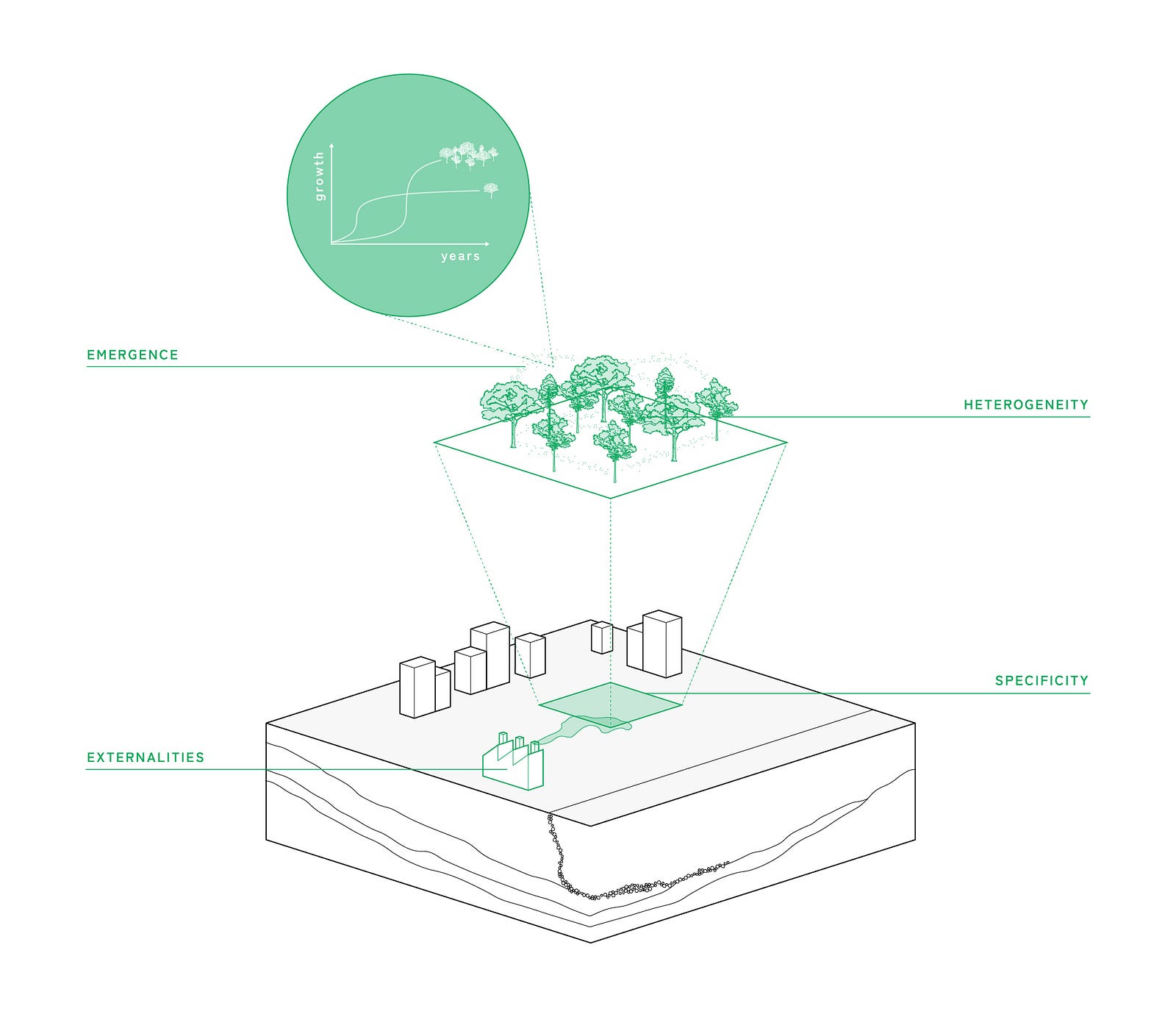 Modelling features of GUS framework representing urban forest as a complex system. Illustration by Seowoo Nam, Lucidminds 2022
This data can be used to provide citizens with information about the carbon cycle and their personal footprint. Also, we can create virtual interactions with nature through gamification techniques which encourage behavior change and a better connection to nature.
Virtual Gatherings
Besides giving access to one's personal emissions, the Digital Twinning scenario also creates a space for the public to gather, reflect and engage in the carbon emission matters together. Just like how many of us started using video calling and online collaboration spaces due to the pandemic, the Digital Twinning scenario creates entirely new ways of gathering and communicating.
One can imagine digital town halls where citizens connect with each other and with city officials to discuss the pressing issue of carbon emissions. Could we even have virtual forest bathing as a team building activity? Or perhaps an online game that connects the citizens with the carbon absorption capacity of their forest?
What's Next
In our next and final blog post, we will explore the last possible future: the Eco Engineering scenario. It will be the most advanced, high-tech scenario and will complete the Green Unified Scenarios (GUS) framework.
Lucidminds AI